The story
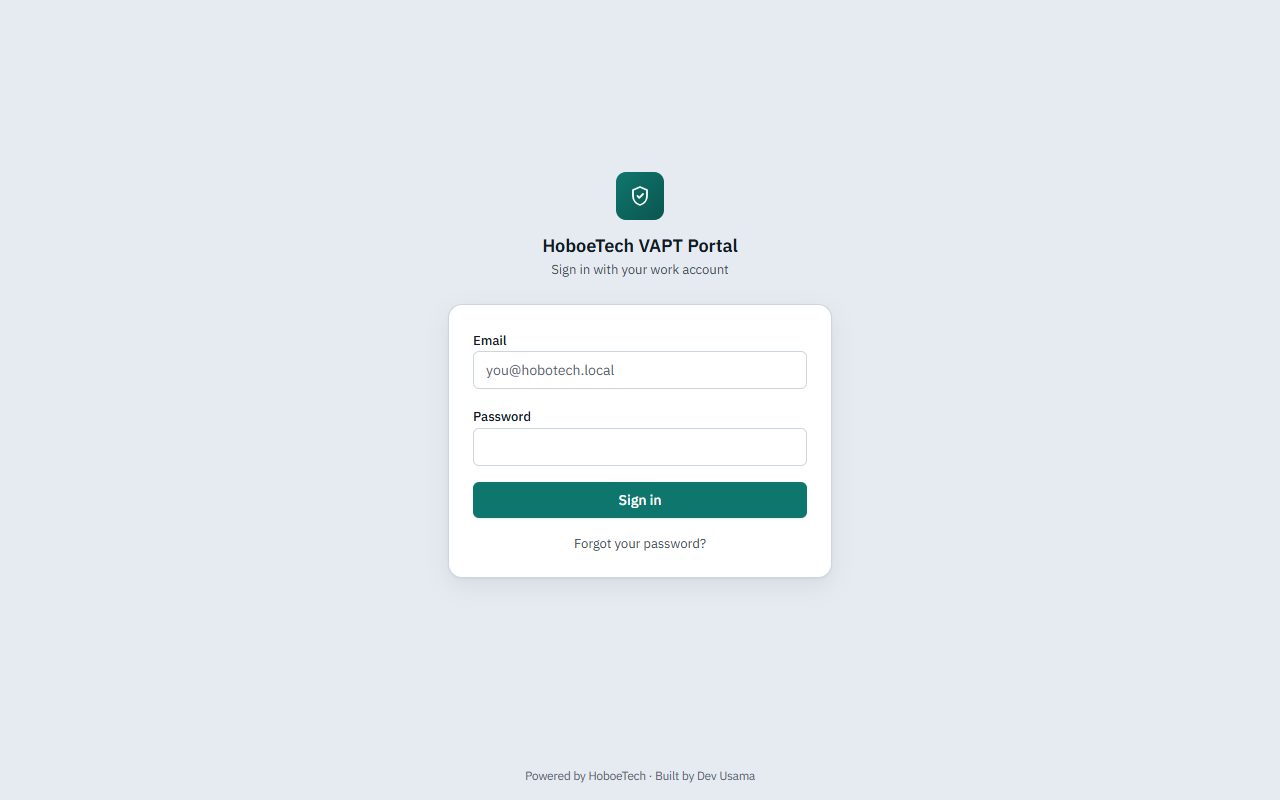
A vulnerability assessment and penetration testing report portal built for HoboTech. Security staff upload a VAPT report PDF and the portal turns it into tracked, assignable work without anyone retyping it.
The problem
A penetration test arrives as a PDF. Every finding in it then has to be transcribed into a tracker by hand before anyone can be assigned to fix it, which is slow, error-prone, and the point at which findings quietly get lost.
Parsing
A background worker extracts the engagement metadata and every individual finding, including title, severity, CVSS score and vector, affected asset, description, impact, remediation steps, evidence and OWASP mapping. The parser was verified against a real 35-page, 22-finding report at full field coverage.
Workflow
Each finding is a ticket. It carries its own status through Open, In Progress, Remediated and Closed, with Risk Accepted and False Positive as explicit terminal states rather than informal ones. An SLA due date is derived from the severity. Assignment sends mail through the client SMTP server and the report appears on the assignee dashboard and calendar.
Authorisation
Closing a finding, accepting risk, or classifying something as a false positive is reserved for staff. Once staff close a finding, an assigned employee cannot reopen or reclassify it. Staff can attach internal notes the assignee never sees, and every ticket keeps a history of who raised it and who assigned it.
Stack notes
Next.js and TypeScript over Prisma and PostgreSQL. NextAuth with argon2 password hashing and TOTP two-factor. Evidence and report files go to S3 through presigned URLs rather than the application server. PDF parsing runs on BullMQ over Redis, so a large report never blocks a request.
What made it hard
Parsing unstructured reports
Extracting every field of every finding from a PDF laid out for human readers, reliably enough that nobody re-checks it by hand
Authorisation that holds
Separating what an assigned employee may do from what security staff may do, so a finding cannot be quietly reopened or reclassified
Long work off the request path
Running multi-page PDF extraction on a queue so an upload returns immediately and a large report cannot time out a web request